
Statistical twins
Who is in the same position as you – just somewhere else?
Neighbours resemble each other; that surprises no one. What is interesting are areas far away that are in the same situation today or have followed the same path. You can learn from them.
Three kinds
Status, trend – and true twins.
- Status twin
- in the same situation today: age, employment, income, housing, settlement
- Trend twin
- same development over 15 years, even if the starting point was different
- True twin
- similar in both – for districts and municipalities at least 100 km away, for neighbourhoods without direct neighbours
Twins show whom a comparison is worth making with – not who is better. They exist for countries, districts, municipalities and neighbourhoods, in the report as in the Online Radar.
Example Merzig-Wadern
True twins in Germany
- Odenwaldkreis (Hesse)
- Lichtenfels (Bavaria)
- Bad Dürkheim (Rhineland-Palatinate)
- Rhein-Lahn-Kreis (Rhineland-Palatinate)
- Südliche Weinstraße (Rhineland-Palatinate)
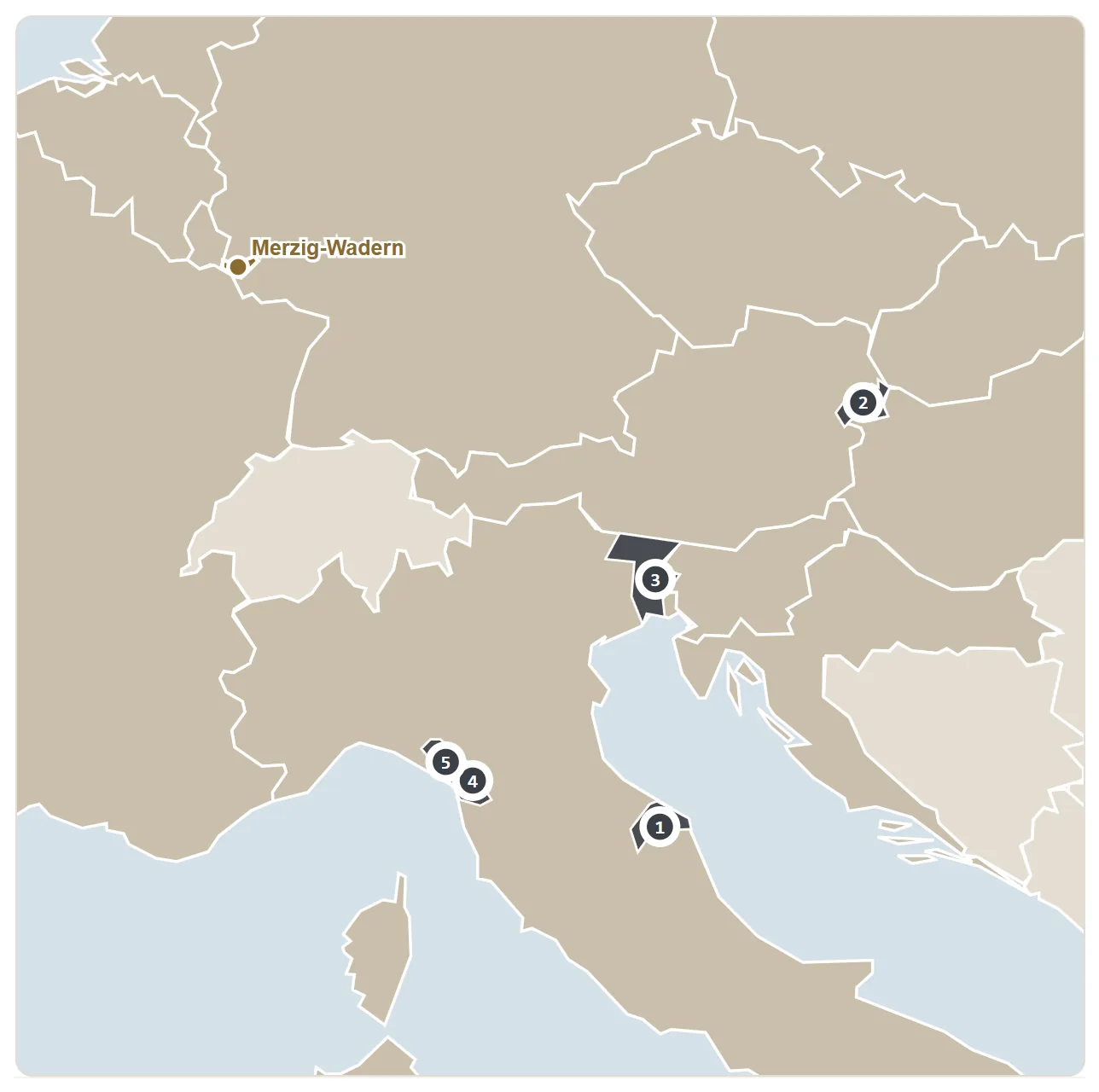
True twins in Europe
- Ancona (Italy)
- Northern Burgenland (Austria)
- Udine (Italy)
- Lucca (Italy)
- Massa-Carrara (Italy)
As of October 2026 · calculation as in the report
Twin compass
All districts at a glance.
Each dot is a district. The horizontal axis shows how similar it is to Merzig-Wadern today, the vertical axis how similar its development was in 2008–2023 – rank 1 is the most similar, the axes are logarithmic.
The true twins are at bottom left. At top left are districts with the same position but a different path; at bottom right, those with the same path but a different position. Hollow circles are neighbours, which do not count as twins.
Sources: Wegweiser Kommune (CC0), Statistische Ämter; own calculation.
Europe
Twins across the border.
For every state and every district we also search in Europe: among 1,201 NUTS-3 regions for districts and 95 NUTS-1 regions for states.
What is compared is the economic structure – the sectors' shares of employment and value added and their change since 2015 – because Eurostat supplies it uniformly for all regions. The characteristics are therefore different from those of the German twins.
Source: Eurostat, Regional economic accounts (CC BY 4.0); map: Natural Earth, EuroGlobalMap © EuroGeographics.
How we calculate
Four steps, traceable.
- 01
Choose characteristics
For the current position, indicators on age, work, income, housing and settlement; for the trend, their change over 15 years.
- 02
Make comparable
Each characteristic is converted into standard deviations of the comparison group so that euros, percentages and square metres fit together.
- 03
Measuring distance
The smaller the distance across all characteristics, the more similar – this gives a rank among all comparison areas.
- 04
Excluding neighbours
Areas in the same state or closer than 100 km do not count as twins; they are named separately as similar neighbours.
Get started
Twins for your area.
In the Online Radar you will find twins for every state and every district – in Germany and Europe.